On Board systems on our UAVs

…enabling SDX1’s mission capabilities

The SDX1 integrates a series of essential avionics, propulsion, and communication subsystems that enable autonomous flight, data acquisition, and real-time mission execution. Each subsystem works together to form a robust and modular architecture designed for future upgrades and expansion. One of these systems is the Raspberry Pi Communication Hub.The Raspberry Pi acts as the central data-handling computer of the SDX1. It interfaces with multiple peripheral modules and serves as the bridge between the UAV and the ground server. This system forms the backbone of SDX1’s connectivity, ensuring reliable communication during long-distance operations.

  • Communicates with the GPS module for real-time position, velocity, and timing data
  • Integrates a 4G/LTE HAT, enabling long-range communication over cellular networks
  • Sends telemetry (position, system health, mission status) to the remote server •Receives commands or mission updates from the server
  • Relays data to and from the flight controller through serial communication
  • Stores mission logs locally for redundancy
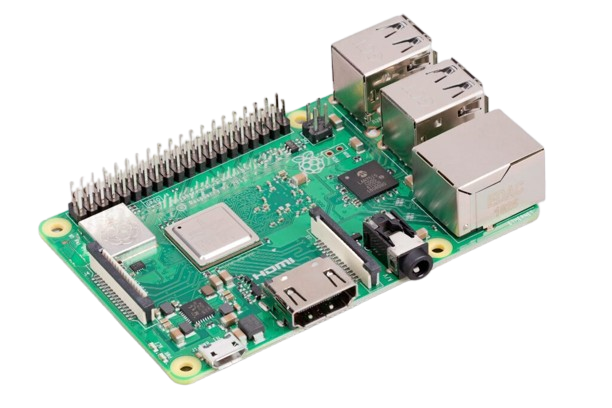
Raspberry Pi 3b+ currently used on the SDX1

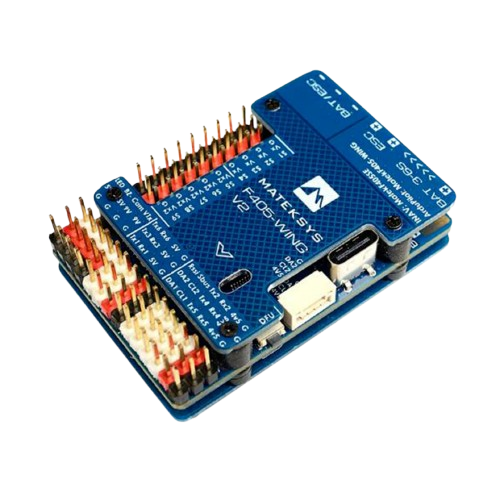
The Mateksys F-405 Wing V2 Flight Controller

Flight Controller & Autopilot System

The flight controller is responsible for the core flight dynamics, stabilization, and autonomous navigation of the SDX1.

  • Runs MAVLink-based firmware compatible with Mission Planner
  • Processes IMU, barometer, magnetometer, and GPS data to maintain stable flight
  • Executes waypoints, automatic takeoff/landing, and return-to-home procedures
  • Interfaces with the Raspberry Pi for telemetry and mission updates
  • Controls the ESC, servos, and motor output signals
  • Monitors flight envelopes and prevents unsafe maneuvers

Li-Ion battery, currently 4 are installed in series providing
the SDX1 with 14.4V and 5000mAh

Power System

The SDX1 uses a high-energy-density Li-ion battery pack to power the propulsion and onboard electronics.

  • Supplies stable voltage to the ESC and propulsion motor
  • Powers the avionics, Raspberry Pi, flight controller, and communication modules
  • Provides long-endurance capability suitable for large-area missions
  • Designed as a modular pack to enable ease of replacement or future expansion
  • A Battery Management System (BMS) will be added to the SDX1, providing enhanced protection, monitoring, and balancing.

Propulsion System

The propulsion system provides the mechanical thrust required for sustained and reliable flight, enabling the SDX1 to maintain stable airspeed, climb efficiently, descend smoothly, and respond precisely to autopilot commands. It delivers consistent performance under varying conditions, keeping the aircraft controllable and energy-efficient while maintaining seamless communication with the flight controller for accurate throttle response and stable propulsion during complex maneuvers or autonomous operations.

  • Brushless DC motor (BLDC) for high efficiency
  • Electronic Speed Controller (ESC) that regulates motor power output
  • Integration with the flight controller for throttle commands
  • Capable of supporting long-endurance cruise flight for fixed-wing missions

5010 motor currently used on the SDX1

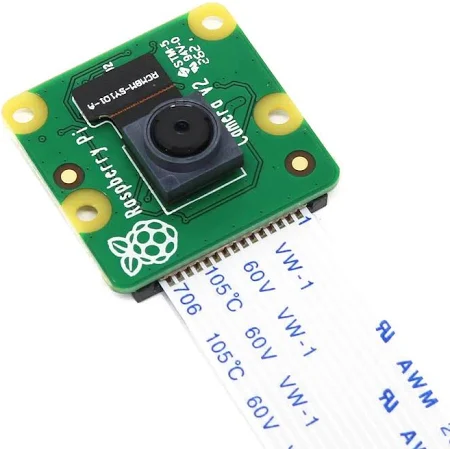
Pi Camera module used on the SDX1

Camera & Imaging System

SDX1 incorporates an onboard camera for real-time mission awareness and data collection. This system enables SDX1 to serve as a flexible platform for multiple mission profiles.

  • Provides consecutive imaging feedback
  • Captures visual data for analysis (fire detection, search-and-rescue, mapping, etc.)
  • Can stream footage over the 4G network or log locally on the Raspberry Pi

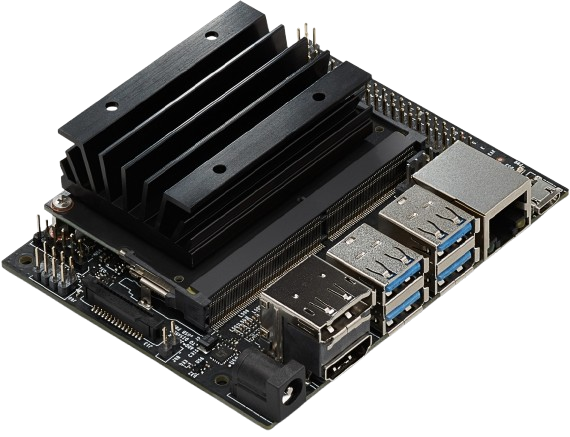
Jetson Nano

Future On-Board AI Processing Unit

A future iteration of the SDX1 will incorporate a dedicated edge-AI computer, such as a Jetson Nano, to run onboard machine-learning models.

  • Real-time object detection (people, vehicles, fires, vessels, etc.)
  • Autonomous decision-making based on environmental input
  • Local processing to reduce reliance on network connection
  • Improved mission independence beyond simple remote commands